Imagine the scent of caramelized lactose hitting the air as a pristine custard undergoes its final transformation. This is not just cooking; it is a high-stakes engineering project where heat serves as the primary architect. We are navigating the precarious bridge between liquid instability and structural permanence. The Bake to Cool Setting is the critical phase where the magic happens. It is that specific window where the oven's aggressive thermal energy retreats, allowing the dairy proteins to lock into a delicate, shimmering matrix. If you pull the trigger too early, you are left with a soup; too late, and you have produced a rubbery, weeping mess. We demand a texture that is silky yet defiant, a gel that yields to the spoon but holds its silhouette on the plate. This audit focuses on the precision required to master this transition. We are looking for the perfect wobble, the golden Maillard crust, and the internal temperature that signals victory. Let us break down the mechanics of the perfect dairy gel.
THE DATA MATRIX
| Metric | Specification |
|---|---|
| Prep Time | 25 minutes |
| Execution Time | 55 minutes |
| Yield | 6 Servings |
| Complexity (1-10) | 7 |
| Estimated Cost per Serving | $2.45 |
THE GATHERS
Ingredient Protocol:
- 500ml / 2 cups Heavy Cream (minimum 36% butterfat)
- 125ml / 0.5 cup Whole Milk
- 100g / 0.5 cup Granulated Sugar
- 6 Large Egg Yolks (approximately 110g)
- 10ml / 2 tsp Pure Vanilla Extract
- 2g / 0.25 tsp Fine Sea Salt
- 50g / 0.25 cup Turbinado Sugar (for the crust)
Section A: Ingredient Quality Audit:
The primary failure point in dairy gels is often the lipid content. If your cream has been ultra-high temperature (UHT) processed too aggressively, the proteins may already be partially denatured, leading to a grainy mouthfeel. Technical Fix: Always opt for pasteurized over UHT when possible to ensure a more stable protein network. If your yolks appear pale, the lecithin content might be low, which affects the emulsification. To compensate, whisk the yolks with the salt five minutes prior to mixing; the salt begins to break down the yolk proteins, making them more receptive to the fats. If your sugar is clumping, it indicates moisture ingress which can disrupt the viscous nature of the base. Sift your dry goods to ensure a homogenous distribution.
THE MASTERCLASS
1. Thermal Infusion and Emulsification
Begin by combining your cream and milk in a heavy-bottomed saucier. Heat the mixture over medium-low until it reaches 80 degrees Celsius. Do not allow it to boil. In a separate bowl, whisk your yolks and granulated sugar until the mixture is pale and thick. Slowly temper the hot cream into the yolks, whisking constantly to prevent scrambling.
Pro Tip: Use a digital scale for your yolks rather than counting by unit. Egg sizes vary wildly, and a 5-gram discrepancy can ruin the Bake to Cool Setting by altering the protein-to-fat ratio. The science here is about creating a stable emulsion before the heat of the oven begins the coagulation process.
2. The Strain and Aeration Purge
Once combined, pass the custard through a fine-mesh chinois into a clean pitcher. This removes any chalazae or accidental protein clumps. Let the mixture sit for at least ten minutes to allow any incorporated air to rise to the surface. Use a blowtorch or a spoon to remove the foam.
Pro Tip: Excessive air trapped in the custard will expand in the oven, creating unsightly bubbles and a porous texture. A professional bench scraper can be used to skim the surface of a wide container if a pitcher is unavailable. You want a dense, bubble-free liquid for a glassy finish.
3. Controlled Coagulation (The Bake)
Place your ramekins in a high-sided roasting pan and fill the pan with boiling water until it reaches halfway up the sides of the molds. Slide the pan into a 150 degree Celsius oven. Bake until the edges are set but the center still retains a distinct jiggle when nudged.
Pro Tip: This is the heart of the Bake to Cool Setting. The water bath (bain-marie) acts as a thermal buffer, ensuring the custard never exceeds 100 degrees Celsius. Use an instant-read thermometer to pull the custards when the internal temperature hits 77 degrees Celsius. This prevents the proteins from over-tightening and squeezing out moisture.
4. The Structural Set (The Cool)
Remove the ramekins from the water bath immediately and let them sit at room temperature for thirty minutes. Afterward, refrigerate them for at least four hours, though overnight is preferable. This allows the fat globules to crystallize and the protein matrix to fully solidify.
Pro Tip: Skipping the room-temperature cooling phase causes "thermal shock," which can lead to condensation forming on the surface. This moisture will dissolve your sugar crust later. Patience is a culinary tool as vital as any knife.
Section B: Prep & Timing Fault-Lines:
The most common human error is the "Peek-a-Boo" syndrome; opening the oven door repeatedly. Each time the door opens, the ambient temperature drops, extending the bake time and risking an uneven set. Use the oven light instead. If your timing is off and the custard looks liquid after the allotted time, check your oven calibration with an external thermometer. Most home ovens are off by at least 10 degrees. If the custard is weeping water (syneresis), you have overbaked it; the protein net has constricted too tightly.
THE VISUAL SPECTRUM
Section C: Thermal & Visual Troubleshooting:
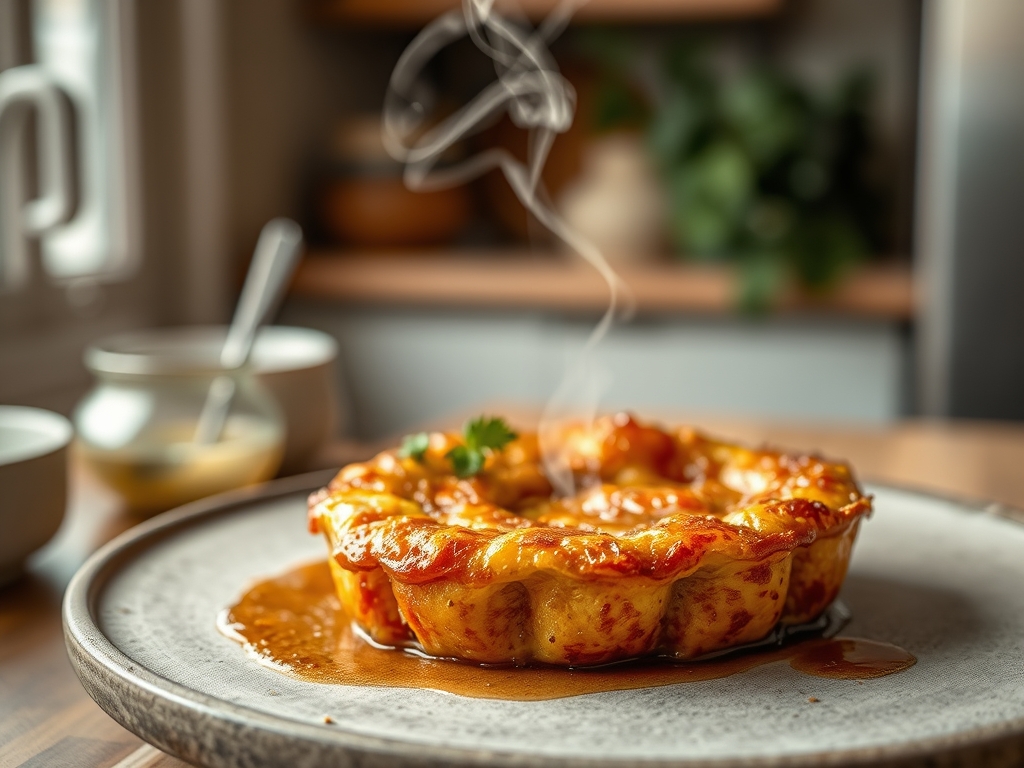
Look at the Masterclass photo above. Notice the uniform, glass-like surface and the absence of weeping at the edges. If your custard has a "honeycomb" texture on the sides, the oven was too hot or the water bath was too shallow. If the top is dull rather than shiny, you likely had too much residual foam before baking. For uneven browning during the final torching, ensure your Turbinado sugar is spread in a perfectly even, thin layer. A thick pile of sugar will burn on top while remaining raw underneath. The goal is a shattered-glass effect that provides a piquant contrast to the creamy interior.
THE DEEP DIVE
Macro Nutrition Profile:
A single serving typically contains 340 calories, 28g of fat, 18g of carbohydrates, and 5g of protein. It is a lipid-heavy profile designed for maximum satiety and flavor delivery.
Dietary Swaps:
- Vegan: Replace heavy cream with full-fat coconut cream and use agar-agar (2g per 500ml) as the setting agent. Note that the Bake to Cool Setting will be faster and firmer.
- Keto: Swap granulated sugar for an erythritol-monk fruit blend. The structural integrity remains similar, though the caramelization of the crust will be less pronounced.
- GF: Naturally gluten-free, provided your vanilla extract is pure and not a grain-based imitation.
Meal Prep & Reheating Science:
These gels are the ultimate make-ahead component. They maintain their molecular structure for up to four days in the cold-chain. Do not attempt to reheat a set dairy gel; the heat will break the emulsion and turn it back into a liquid. Always serve chilled, torching the sugar immediately before consumption to maintain the contrast between the cold gel and the hot, crackling crust.
THE KITCHEN TABLE
Why is my custard still liquid after cooling?
You likely pulled it before the internal temperature reached 77 degrees Celsius. The proteins haven't bonded. Return them to a water bath in the oven; you can often save a "soft" set with a secondary thermal application.
Can I use a broiler instead of a torch?
The broiler is a blunt instrument. It heats the entire custard, risking a melt-down of your hard-earned structure. A torch provides localized, intense heat that caramelizes the sugar while leaving the dairy gel beneath it perfectly chilled.
What causes the "eggy" smell in some custards?
Overcooking is the culprit. When egg proteins are subjected to excessive heat, they release sulfur. Precise temperature control via a digital probe is your best defense against a sulfurous profile. Aim for that 77-degree sweet spot.
How do I get a perfectly flat sugar crust?
After sprinkling the sugar, tilt the ramekin and tap the sides to distribute it evenly. Pour off any excess. A thin, uniform layer ensures the heat from the torch melts the sugar into a single, cohesive pane of caramel.